
The Plan to End Property Tax
To know where we are, we need to understand where we began.
Property Tax: Brief History
Kentucky became a state in 1792. Having no income tax and minimal commercial activity to generate revenue for critical services and schools, a property tax was adopted to generate the necessary revenue to fund such services. This has been the backbone and the staple of funding our public services and schools. The key issues with property tax in that era were that wealthy landowners would often under-report their property values, small farmers carried a disproportionate burden, uneven enforcement between rural and urban communities, inconsistent collection and disbursement from local sheriff’s offices, and persistent assessment disparities. It’s worth noting that PVAs (Property Value Assessors) were not implemented in Kentucky until 1912. This means that for 120 years property values were, at the time, subjective at best.
Some of these tensions are still alive today. We’ve witnessed property values in rural areas (lower income areas) rival property values in urban and suburban communities (higher income areas). We’ve watched as the values of our properties increase while we struggle to keep up with the increasing tax bills. This trajectory has put many of our veterans, retirees, disabled, and low income families at risk of losing their homes. It has also made it nearly impossible for first time home buyers to enter the housing market when coupled with higher interest rates.
Sales Tax: Brief History
In 1934, after the Great Depression, Kentucky added a temporary 3% sales tax that was later repealed in 1936. Then, in 1960, Kentucky adopted the framework to what is now our modern sales tax system. Sales tax has increased over time since 1960. It started at 3% and was increased to 5% in 1968. 22 years later, in 1990, we saw the sales tax increase again to it’s current 6%.
Income Tax: Brief History
From our founding in 1792, Kentucky made an attempt to implement a 5% partial income tax in 1867 which lasted until 1872 when it was deemed unconstitutional by the Kentucky Court of Appeals. It wasn’t until 1936 that Kentucky became the 29th state to adopt a general individual income tax. The tax rate was a graduated rate structure from 2% – 5% for individuals. The rate fluctuated some over time and reached as high as 6% in 2010.
Kentucky began gradually shifting from an income tax model to a consumption/usage based tax system since 2018 with HB 366. This bill expanded the sales tax base to include bowling centers, skating rinks, weight training facilities, and golf courses (public and private). It also included the expansion to pet care (boarding and grooming), veterinary services (small animals), dry cleaning, and indoor tanning. Many other services were included like landscaping (tree trimming, lawn care, snow plow), cleaning services, and limousine services (with driver).
In 2023 further expansion of the consumption/usage tax was implemented with HB 8 which added 30 more service categories that included photography, cosmetic surgery (non-medical), social event planning, and parking services (excluding educational institutions).
HB 1, passed in 2025, began reducing the states income tax. This reduction was part of HB 8 which created a trigger-based system reducing the state income tax by 0.5% annually beginning January 1, 2026 provided certain fiscal conditions such as maintaining a sufficient rainy day fund were met.
Moving Forward for Kentucky
How History Shapes Our Future
Fortunately, times have changed. Kentucky has progressed and has now outgrown the need for a tax that has been part of our foundation and also the cause of so much tension and animosity within the Commonwealth for 234 years.
Kentucky’s history has proven it’s taxation and rates are subject to change, adapt, and can be removed under the appropriate circumstances. This is especially true with the sales tax.
As we’ve learned, Kentucky’s tax rates (sales and income) have decreased and increased over the years. We’ve also learned that Kentucky has increased it’s sales tax base to include a multitude of services that were previously exempt.
This is were the plan began.
Using the already implemented system of usage/consumption form of taxation to eliminate the state income tax, we can utilize this same mechanism to eliminate property tax. As shown with HB 366 and HB 8, a change is necessary to replace the missing revenue to get us to where we want to go, the elimination of property tax.
My proposed change would be a potential 2% – 3% increase in state sales tax. This increase is subject to change based on projected revenue numbers from the Revenue Department’s annual reports. Furthermore, to capitalize on Kentucky’s ever growing tourism, visitors to our wonderful Commonwealth would also be contributing to a higher standard than normal. Doing so, would assist in generating additional revenue for all the things property tax currently funds.
Under my plan, schools and critical services will continue to receive full funding as they always have. My plan does not include any additional taxing categories. Everything that you are currently paying sales tax on would remain the same. The funds collected would be allocated to each city and county to be distributed to their SPGEs (schools, fire/ems, library, etc.) that property taxes currently fund to ensure that all current services continue to receive full funding. It is anticipated that those services would possibly receive increased funding.
Additionally, my plan would eliminate taxes on your personal vehicles, motorcycles, and boats. No more annoying vehicle tax bills! The idea is to adopt the Montana vehicle tax plan that can be seen here.
There are many questions and concerns with my plan. All the concerns are completely understandable. I’m confident that under my plan all Kentuckians would benefit from the changes I look to make.
Will Schools and Services Lose Their Funding?
Absolutely not!
Schools will continue to receive full funding as normal as will all other services incuding law enforcement, libraries, and tourism.
Currently, local property tax accounts for 60% of the funding for schools while SEEK funding accounts for 40% which is far less than it’s original intent. SEEK is funded primarily through income and sales tax and was meant to provide relief for increasing property taxes. However, with changes to the SEEK program, the percentage has decresed, property taxes have increased, and the disparity between lower income and higher income communities has increased.
Since income tax is slowly being dissolved, moving to fund it solely through sales tax seems to be the logical step. Otherwise, we’re going to be faced with local municipalities increasing their property tax rates to account for the shortfall of funding. Placing an even heavier burden on lower income areas, property owners, retirees, and fixed income house holds.
Ending Property Tax: What it means.
Ending property tax is a complex and confusing issue. Like with any change, there will be misconceptions, misunderstandings, opposition, and unfortunately, plenty of misinformation.
While opposition may want to focus on negativity, I prefer ideas that focus on positive growth for our Commononwealth’s communities. Ending property tax is one of those ideas.
Now let’s take a look at some of the key benefits of ending property tax.
1. Direct Financial Relief for Homeowners and Property Owners
- Lower ongoing housing costs: Kentucky has a relatively low effective property tax rate (~0.73% on owner-occupied housing), but eliminating it would still save the average homeowner hundreds to thousands of dollars annually, depending on property value. This is especially helpful for fixed-income retirees, the disabled, families, and those in areas with rising assessments.
- True homeownership: You’re “renting from the government” via perpetual taxes, even after the mortgage is paid off. This could reduce forced sales or equity loss for seniors and long-term residents.
- Relief on business and agricultural property: Farms, commercial real estate, and personal property (Kentucky taxes more tangible personal property than many states) would see big cost reductions, potentially offering lower prices for goods/services or improving farm viability.
2. Economic Growth and Housing Market Boost
- Increased housing affordability and mobility: Lower total cost of ownership could make Kentucky more attractive for buyers, retirees, and migrants, boosting demand, home values (to some degree), and construction.
- Business and investment incentives: Reduced costs for commercial/industrial property could attract companies, encourage expansion, and improve competitiveness—especially vs. high-tax states. This aligns with broader tax-cut strategies Kentucky has pursued (e.g., income tax reductions).
- Wealth-building effects: Homeowners could retain more equity and disposable income for spending, saving, or investing, stimulating local economies.
3. Incentives for Efficient Government and Tax Reform
- Pressure for spending restraint and efficiency: Local governments (counties, cities, schools) rely heavily on property taxes—e.g., ~35% of county revenue on average (higher in some), and a major local share for schools (~24% of total school revenue, 72% of local school revenue). Elimination would force prioritization, cuts to waste, consolidation, or user fees/charges for services.
- Shift away from volatile or disliked taxation: Property taxes are stable but unpopular and can rise with assessments even if rates are rolled back. Replacing them could create a different, potentially more predictable system.
- Simpler administration: No more annual assessments, appeals, or PVA (Property Valuation Administrator) operations for ad valorem taxes. This means that your property would be assesed at the time of sale and taxation would be applied appropriately.
Ending Property Tax: By the Numbers
Now that we have the history, the main question, and the benefits taken care of, let’s take a look at the numbers.
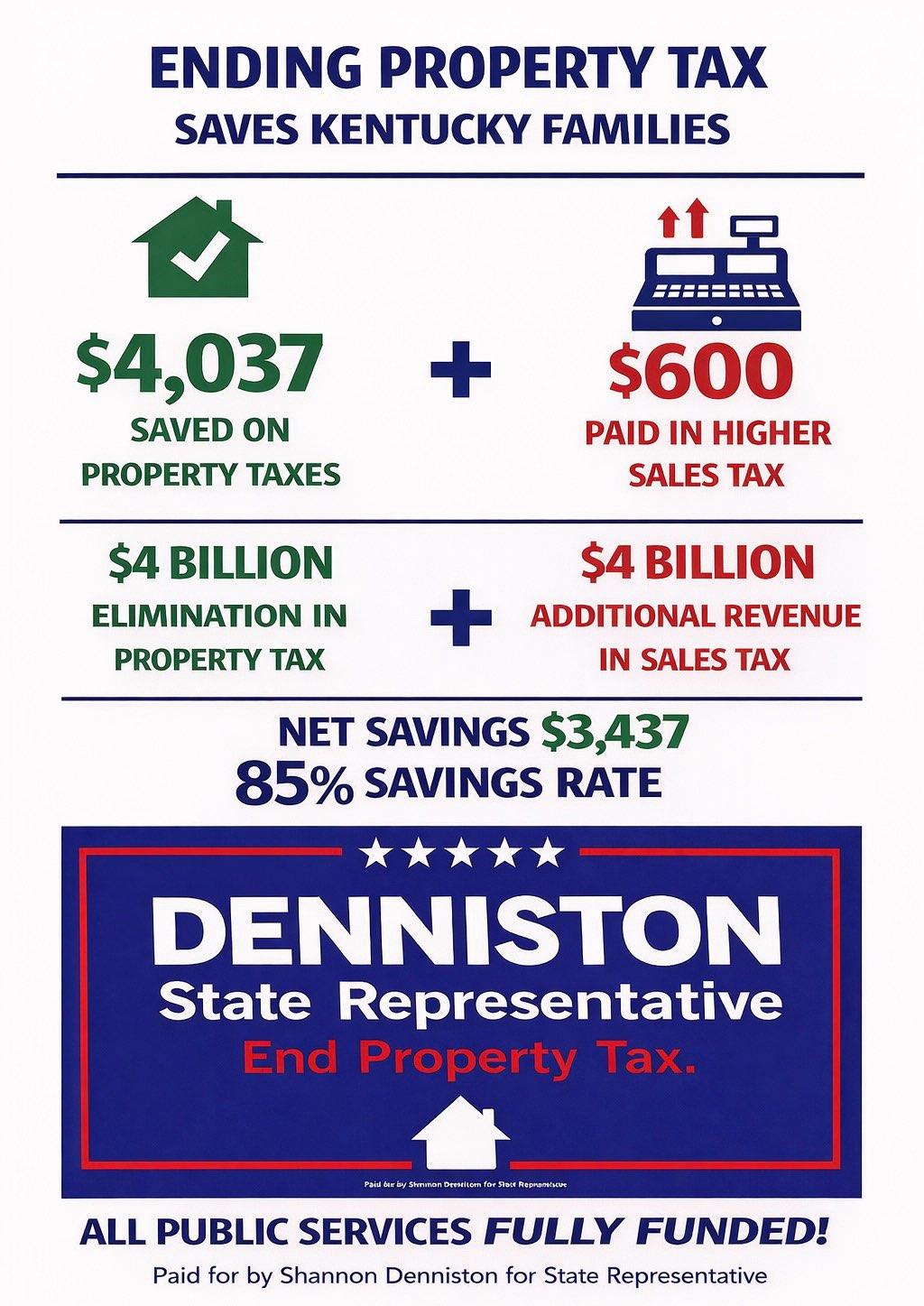
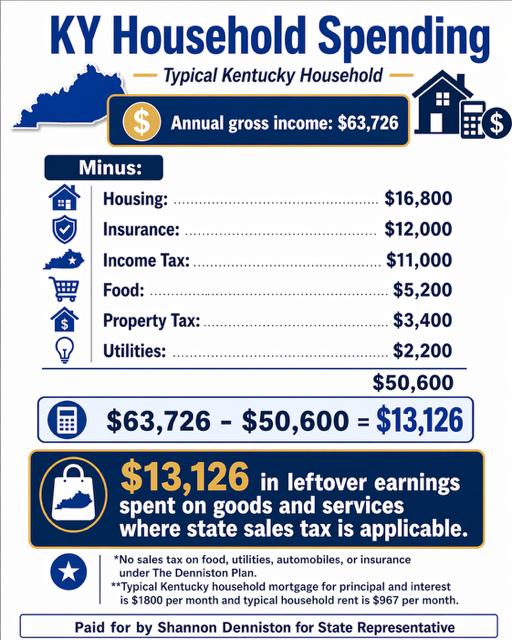
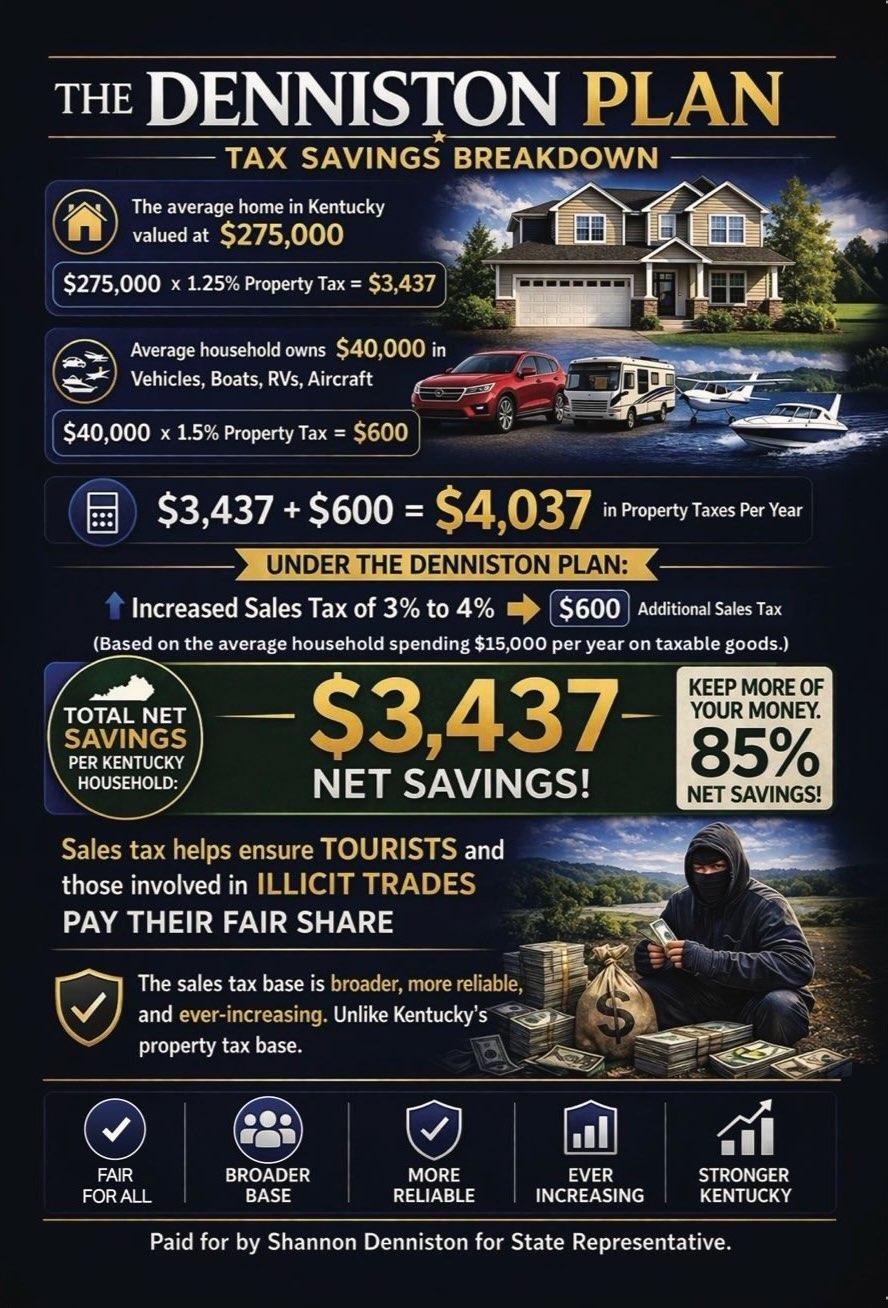
To the right are some infographics that lay out my plan by the numbers demonstrating the viability and benefits of the ending of property tax for the wonderful and hard working people of our Commonwealth.
How This All Ties Together
The previous information is for your reading and understanding. I wanted to share that with you so that you can see that each category of taxation is subject to change based on the needs of Kentucky. During the founding of our Commonwealth, there was a need for property tax. It was implemented to help us grow as a state. For 234 years property tax has served it’s purpose. We’ve grown in population, expanded industry, and developed tourism. Now is the time to move away from the government leveraging your property to fund out of control spending.
As people of this great and wonderful Commonwealth, the government is always asking us to “tighten our belts” when financial times get tough for us. It’s about time we force our government to do exactly that.
Kentucky has a unique opportunity. We are in a place to where we can bring about positive change to the Commonwealth and implement a driving mechanism to bring new businesses and jobs, residents, increased housing, and continue to make our beautiful state flourish all while keeping people in their homes. This is no small task and I do not take it lightly.
I would love to be able to completely rip the bandage off and end property taxes completely. However, with other bills I’ve helped pass, I understand how the legislative process works and what is required to make my plan a viable bill for consideration and get it passed on the House floor. This will be a process and with the support I have awaiting me in the Frankfort, I will be able to hit the ground running.
I have been passionate about the ending of property tax for over 20 years. Like you, I have complained about it to almost anyone who would listen. So I made the decision to put myself in the fight. This isn’t just my fight. This is our fight. This is our time to make a change that other states like Florida and Ohio are working toward. Even President Donald John Trump is on board with the end of property tax nationwide. Let’s make Kentucky a state that is ahead of the curve.
We can do this.
WE WILL DO THIS!!